

The 20th Scientific Annual International Conference for Business
SICB 2027
Conference
20 – 21 April 2027 Al-Zaytoonah University of Jordan
Amman, Jordan
Digital Innovation and Entrepreneurship
Connecting research, innovation, and industry
for a more sustainable digital future.
Submit a Paper Author Login & Paper Status Download Conference Brochure
Research Innovation Impact

Al-Zaytoonah University of Jordan Faculty of Business Amman, Jordan
The conference opens on in Amman (Jordan time, GMT+3). Paper submissions close on .
About the Conference
A leading international forum for digital innovation research.
The 20th International Scientific Conference on Business (SICB 2027), “Digital Innovation and Entrepreneurship,” is a leading international forum dedicated to advancing research in the fields of digital innovation to achieve sustainable entrepreneurship. The conference will be held at the Faculty of Business, Al-Zaytoonah University of Jordan, from 20 to 21 April 2027, bringing together researchers, academics, business specialists, policymakers, and innovators from around the world to discuss the global challenges and opportunities arising from digital transformation and its role in achieving entrepreneurship.
01 The platform
02 The opportunity
03 The aims
The SICB 2027 conference constitutes a distinguished, multi-purpose platform for presenting the latest research and practical solutions in the fields of digital innovation and technological transformation in vital sectors, artificial intelligence and modern technologies in entrepreneurship, digital business models and sustainability, digital entrepreneurship and startups, and building digital capacities and skills — through keynote speeches, lectures, and panel discussions with entrepreneurs from various sectors.
The SICB 2027 conference offers a unique opportunity to exchange knowledge, present creative ideas, build international partnerships, and contribute to shaping a smarter future by highlighting the pivotal role of digital innovation in strengthening entrepreneurship. Together, digital innovation and entrepreneurship form a key driver of the modern economy, given their ability to create high-quality opportunities by integrating contemporary technologies with creative ideas to produce sustainable and scalable business models, and to support sustainable growth pathways at both the corporate and national-economy levels.
The conference aims to advance research and knowledge in digital innovation and entrepreneurship, while exploring the role of artificial intelligence and emerging technologies in developing innovative, sustainable, and scalable business models. The conference also seeks to support digital transformation, develop digital and entrepreneurial capabilities, and foster collaboration among academics, entrepreneurs, business leaders, and policymakers, contributing to international partnerships, innovative solutions, competitiveness, and sustainable economic growth.
countries on the Scientific Committee
research tracks
days of keynotes, lectures, and panels
page limit per submitted paper
Only accepted papers that are presented at the conference will be published in the Springer proceedings and submitted for Scopus indexing, subject to the publisher’s approval and to meeting the publication and indexing requirements. An accepted paper that is not presented will not be published.
Previous Conferences
Nineteen editions before this one
Highlights from SICB 2025, the previous edition of the conference.
Visit past conference websites
Every edition since 2001
Nineteen conferences, one theme each
- 2025 — 19th SICB: Artificial Intelligence in Business
- 2023 — 18th SICB: Sustainability and Cutting-Edge Business Technologies
- 2021 — 17th SICB: The Digital Economy and Business Analytics
- 2017 — 16th SICB: Engineering, Project, and Production Management
- 2016 — 15th SICB: Sustainability and Competitiveness in Business
- 2015 — 14th SICB: Innovation Management in Business
- 2014 — 13th SICB: Crisis Management in a Changing World
- 2013 — 12th SICB: Human Capital in a Knowledge Economy
- 2011 — 11th SICB: Business Intelligence and Knowledge Economy
- 2010 — 10th SICB: Entrepreneurship within Knowledge Society
- 2009 — 9th SICB: Environmental Economics and Globalization
- 2008 — 8th SICB: Change Management and Knowledge Society
- 2007 — 7th SICB: Risk Management and Knowledge Economy
- 2006 — 6th SICB: Business Ethics and Knowledge Society
- 2005 — 5th SICB: Knowledge Economy and Economic Development
- 2004 — 4th SICB: Knowledge Management in the Arab World
- 2003 — 3rd SICB: E-Business in the Arab World
- 2002 — 2nd SICB: Information Technology and Its Role in Economic Development
- 2001 — 1st SICB: Informatics and Its Role in the Arab Economies
Published Proceedings
SICB research published by Springer Nature, by conference year:
2025
19th SICB
Artificial Intelligence in Business: Applications and Ethical Considerations in the Digital Age – Volume 1 Lecture Notes in Networks and Systems, vol. 1502 · 30 papers · published 2025 Artificial Intelligence in Business: Applications and Ethical Considerations in the Digital Age – Volume 2 Lecture Notes in Networks and Systems, vol. 1503 · 32 papers · published 2026 Applied Artificial Intelligence in Business: Systems, Tools and Techniques Studies in Systems, Decision and Control, vol. 597 · 58 chapters · published 2025
2023
18th SICB
Cutting-Edge Business Technologies in the Big Data Era – Volume 1 Studies in Big Data, vol. 135 · published 2023 Cutting-Edge Business Technologies in the Big Data Era – Volume 2 Studies in Big Data, vol. 136 · 35 papers · published 2023
2021
17th SICB
Call for Papers Present your research to the world Publication Your paper, in Springer proceedings Community Researchers from across the world, in one room Deadline Submissions close 1 February 2027 Free attendance No fees for authors of accepted papers 20–21 April 2027 · Amman Be part of the 20th SICB
Nineteen editions of research Researchers from across the world Ideas that became published papers Submitted for Scopus indexing Published with Springer Your research belongs here Be part of the 20th SICB
Conference Topics
Five tracks
Select a track, or let them change on their own every 7 seconds.
Track I: Digital Innovation and Technological Transformation in Vital Sectors
- Financial Technology (FinTech)
- Accounting and Auditing
- Digital Education (EdTech)
- Digital Health (HealthTech)
- E-business and smart supply chains
- Digital transformation and its role in reshaping economic sectors
Track II: Artificial Intelligence and Modern Technologies in Entrepreneurship
- Applications of artificial intelligence in business and service development
- Internet of Things (IoT) and Blockchain in business
- Big data analytics and decision support systems
Track III: Digital Business Models and Sustainability
- Designing and developing innovative digital business models
- Sustainability of the digital economy and digital platforms
- Open innovation and strategic partnerships
- The digital economy and sustainable financial intelligence
Track IV: Digital Entrepreneurship and Startups
- Digital business environments and incubators
- Financing digital entrepreneurial projects and venture capital
- Risk management in emerging technology projects
Track V: Building Digital Capacities and Skills
- Future digital skills and digital marketing
- Digital leadership and innovation management
- Business intelligence and financial stability
- Empowering youth and women in digital entrepreneurship
Call for Papers
Submit your research to SICB 2027
Read before you submit
- Maximum similarity index 15%. All submitted papers are checked with plagiarism detection software; the similarity index must not exceed 15%.
- Generative AI is not allowed. Generative AI tools may not be used to write the paper, generate its content or analyse its data. AI tools cannot be listed as authors or co-authors, and authors are fully responsible for every part of their paper.
The Faculty of Business at Al-Zaytoonah University of Jordan invites researchers, academics, business specialists, policymakers, and innovators to submit original papers to the 20th Scientific Annual International Conference for Business. Contributions are welcome across all five conference tracks.
Submission deadline
1 February 2027
Submission and registration are handled through the EDAS conference system.
Author Login & Paper Status EDAS Help
Language English only All papers are written and presented in English, with an abstract enclosed.
Length 8 pages maximum Written to academic criteria, using the SICB 2027 template, based on Springer’s proceedings format.
Peer review Double-blind Reviewed by at least three independent reviewers. Authors and reviewers remain anonymous to each other.
Publication Springer proceedings Accepted papers are published in the conference proceedings by Springer and submitted for indexing in Scopus, subject to the publisher’s approval.
Fees Free attendance Attendance is free for authors of accepted papers. There are no submission or registration fees. Travel, accommodation, and subsistence remain the responsibility of each participant.
How to take part
01 Prepare
Prepare your paper with the SICB 2027 Word template.
- Anonymise for review Remove author names, affiliations and acknowledgements from the version submitted for double-blind review.
- Submit as PDF Upload the review version as a PDF; source files are needed only for the camera-ready version.
02 Submit
Manuscripts must be submitted only through EDAS, where they are also reviewed. If you are new to the platform, see the EDAS documentation.
- 1 Create your EDAS account Click New User at edas.info. Your name and affiliation must match those printed on the paper.
- 2 Register the paper Enter the title (not in all capitals) and abstract, then choose the track and topics that fit best.
- 3 Add co-authors Every author needs an EDAS account; add them from the paper page and set the author order.
- 4 Upload the PDF You can replace the file until the deadline; to update it, upload again rather than registering a new paper.
- 1 Feb 2027 Last day to submit
03 After acceptance
- 7 Feb 2027 Notification of acceptance through EDAS
- 14 Feb 2027 Upload the camera-ready paper to EDAS
- 20–21 Apr 2027 Present your paper in Amman
- Register and present At least one author of each accepted paper is expected to register and present it for the paper to be included in the proceedings.
- Consent to Publish Sign the Springer Consent to Publish form and upload it with the camera-ready paper.
Instructions for authors
- All submitted papers should be in accordance with the main themes of the conference.
- Submitted papers should not have been previously published or are currently under consideration for publication in any other scientific journal or conference.
- The official language of the conference is English, and all papers must be written and presented in English.
- Author should enclose an abstract in English with submitted papers.
- Research papers should be written according to the academic writing criteria, and should use the SICB 2027 template, based on Springer’s proceedings format.
- Manuscripts must be submitted only through the EDAS conference system.
- Every submitted paper is double-blind reviewed by at least three independent reviewers from the Scientific Committee: authors and reviewers do not know each other’s identities.
- Submitted papers should not exceed 8 pages.
- The Conference Committee is not obliged to provide a justification for rejected papers.
- Only accepted papers that are presented at the conference will be published in the Springer proceedings and submitted for Scopus indexing, subject to the publisher’s approval and to meeting the publication and indexing requirements. An accepted paper that is not presented will not be published.
Questions, or need an invitation letter for a visa? Write to sicb@zuj.edu.jo.
Important Dates
The road to April 2027
Every date below is firm.
Review takes time, and the publication schedule with Springer leaves no room to extend it — papers that arrive by the deadline go to the Scientific Committee, and late ones cannot be considered. Submit early: the system opened in August 2026, and early submissions get the fullest reviewer feedback.
- 18 August 2026 — Submission System Opens
- 1 February 2027 — Deadline for Submission
- 7 February 2027 — Notification of Acceptance
- 14 February 2027 — Camera Ready Submission
- 20–21 April 2027 — Conference Date
Committees
Who runs the conference
The conference is supervised by the Faculty of Business at Al-Zaytoonah University of Jordan. The Scientific Committee comprises twenty-five researchers and experts drawn from fourteen Arab and international countries.
Preparatory Committee
- Prof. Abdul Razzak K. Al-Shehadeh — Chair
- Dr. Ihab AL-Qirem
- Prof. Saad G. Yaseen
- Prof. Raed Kareem Kanaan
- Prof. Raed Alqirem
- Prof. Dima Al-Dajani
- Prof. Ayman Al-Smadi
- Dr. Isra Saeed Al_Khateeb
- Dr. Maha Diab Ali Ayoush
- Dr. Ayman Mohammed Mansour
- Dr. Mohammad Al-Hur
Scientific Committee 14 countries
- Prof. Abdul Razzak K. Al-Shehadeh (Jordan)
- Prof. Amirouche Bouchelaghem (Algeria)
- Prof. Mohammad Madi (USA)
- Prof. Jamal Abu Rashed (USA)
- Prof. Abdul Nasir Humaydan (Syria)
- Prof. Tarek Al-Haj (Palestine)
- Prof. Ghaleb Al-Refae (UAE)
- Prof. Kamel Rezig (Algeria)
- Prof. Farid Kourtel (Algeria)
- Prof. Asniati Bahari (Indonesia)
- Prof. Abdul Nasir Nour (Palestine)
- Prof. Antonio Del Pozzo (Italy)
- Prof. Oscar Suarez Fernandez (Spain)
- Prof. Francisco-Jesus Ferreiro-Seoane (Spain)
- Prof. Manuel Octavio Del Campo Villares (Spain)
- Prof. Bob Castaneda (USA)
- Prof. John Palmer (USA)
- Prof. Monica Violeta Achim (Romania)
- Prof. Hussain Ali Bakhet (Iraq)
- Prof. Rusli J. Kaddo (USA)
- Prof. Hawari Merag (Algeria)
- Prof. Mahmoud Khalid Almsafir (Qatar)
- Dr. Mohammad Kudari (Malaysia)
- Dr. Murad Al-Zaqeba (Malaysia)
- Dr. Adnan Tah (UK)
Why come to Jordan
Present your research where three continents meet.
Jordan holds six UNESCO World Heritage sites in a country you can cross in a single day, and the conference sits in the middle of it. Two working days in Amman leave a weekend for the rest: a Nabataean city cut into rose-red sandstone, a desert valley of granite towers, the lowest shore on Earth, a Roman provincial capital still standing. Delegates who plan a few extra days around the sessions rarely regret them.
Amman (Capital)
The conference city: the Citadel and its Temple of Hercules on Jabal al-Qal’a, a Roman theatre seating six thousand, and the galleries and cafés of Jabal Amman.

Petra (3 hrs south)
The Nabataean capital carved into rose-red sandstone, reached on foot through the Siq gorge. A UNESCO World Heritage site and one of the New Seven Wonders of the World.

Wadi Rum (4 hrs south)
A protected desert valley of sandstone and granite in the far south, inscribed by UNESCO as a mixed natural and cultural World Heritage site, known for its rock inscriptions and Bedouin camps.

The Dead Sea (1 hr west)
The lowest point on the land surface of the Earth. Its hypersaline water carries so much dissolved mineral salt that swimmers float; the shoreline is about an hour from Amman.

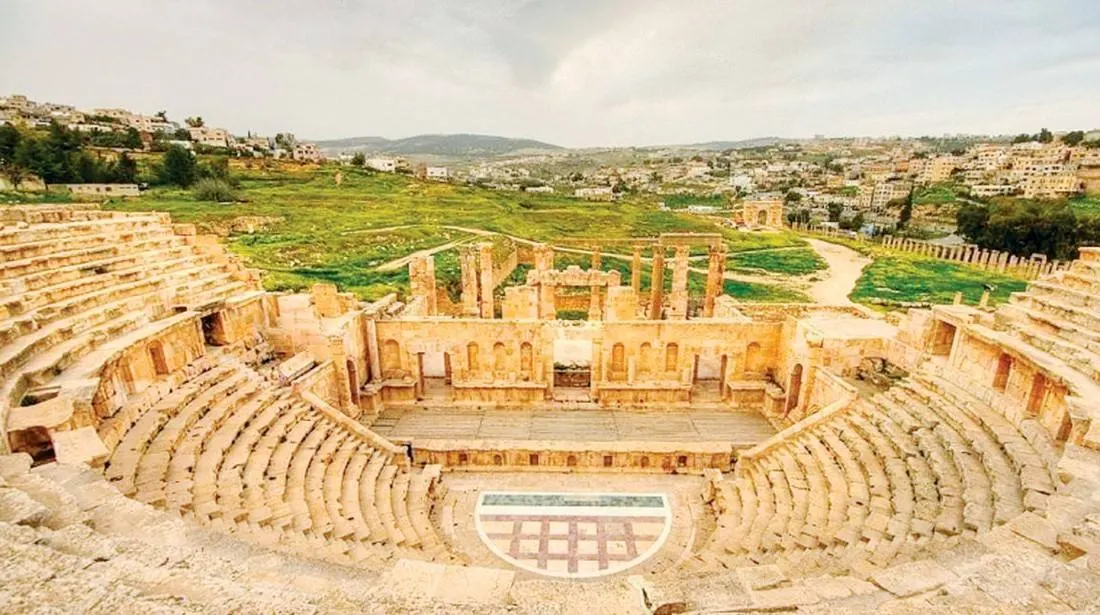
Jerash (1 hr north)
One of the best-preserved Greco-Roman provincial cities anywhere, with colonnaded streets, two theatres, and an oval forum, about 48 km north of Amman.
Aqaba (4 hrs south)
Jordan’s only coastal city, on the northern tip of the Red Sea, with coral reefs, year-round diving, and a duty-free special economic zone.

Arriving
Queen Alia International Airport lies 35 km south of Amman, with direct flights from Europe, the Gulf, and North America, and highway, bus, and taxi links to the city.
Entry
Many nationalities may obtain a visa on arrival; check your own case before travelling. The Jordan Pass, bought online in advance, covers the visa fee and entry to some forty sites. jordanpass.jo
April weather
The mildest month of the year: roughly 15 to 25 °C in Amman, warm and dry before the summer heat, and comfortable for travel in the south.
On the ground
Arabic is the official language and English is widely spoken at universities and hotels. The currency is the Jordanian dinar; cards are accepted across Amman. visitjordan.com
The venue
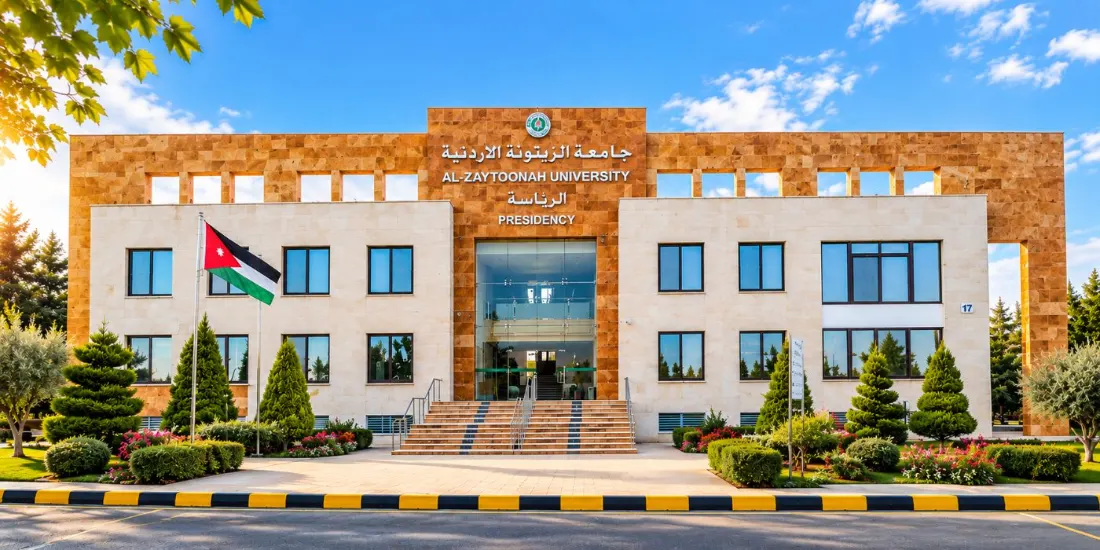
Al-Zaytoonah University of Jordan
Faculty of Business
Airport Road, Amman, Jordan
About 25 minutes from Queen Alia International Airport and 20 minutes from central Amman.
Questions
Before you submit
The answers authors ask for most often. Anything else goes to the conference office by email.
When and where is SICB 2027 held?
The conference runs over two days, 20 to 21 April 2027, at the Faculty of Business, Al-Zaytoonah University of Jordan, in Amman.
Who should attend?
Faculty members, postgraduate students, and practising specialists, alongside researchers, policymakers, and innovators from around the world.
Where are accepted papers published?
Only accepted papers that are presented at the conference will be published in the Springer proceedings and submitted for Scopus indexing, subject to the publisher’s approval and to meeting the publication and indexing requirements. An accepted paper that is not presented will not be published.
Is there a participation fee?
No. Authors of accepted papers attend free; travel and accommodation are their own. Details are under Call for Papers.
How long may a paper be?
Submitted papers should not exceed 8 pages, written to academic writing criteria and using the SICB 2027 template, based on Springer’s proceedings format.
In what language are sessions held?
English. Papers are written and presented in English.
How do I submit?
Manuscripts are submitted electronically only, through the EDAS conference system. Submit through the Submit a Paper button on this page; submissions close 1 February 2027. If the platform is new to you, see the EDAS documentation.
Contact
Write to the conference office
Paper correspondence runs through EDAS. For everything else — visas, travel, participation — email the Organising Committee.
Emailsicb@zuj.edu.jo Your paper EDAS — login & paper status News SICB on Facebook